|
Heybridge
Basin (Cannibal
Island) |
|
|
Click
on underlined blue names for link to more details |
|
|
Prominent families
in the development of the village |
|
'Darby'
Stebbens |
|
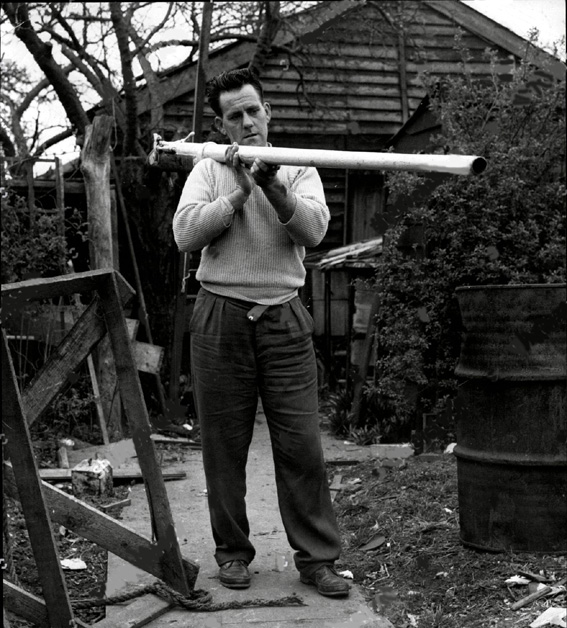
(below) 'Darby' in the back garden of his house in Basin
Road, showing his home made punt gun. |
 |
|
 |
|
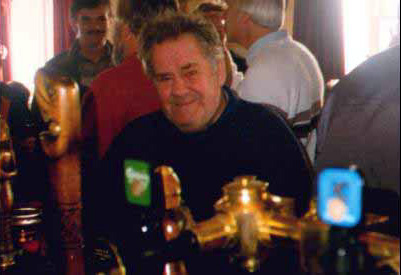
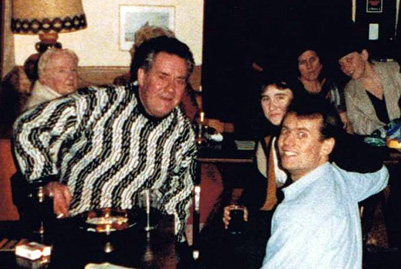
(above)
'Darby' in the 'Jolly
Sailor'in the 1980's |
|
|
Ivan David Stebbens was
born on Lock Hill, Heybridge Basin, on New Year's Day 1929. C.C.L
Stebbens had two sons: Cecil Charles Augustus (b 1926) and Ivan
David. Ivan married Janet Thimbleby in 1957. His father was the river pilot and was often away.
Just before he was born his mother decided that she would stay
with her mother in-law who was the landlady of 'The Old Ship'
so she could be sure to have some company and help. He was known
locally as 'Darby' or 'Darb' to his closest friends. He was one
of the last of the Basin's sons who lived by their wits on and
off the foreshore, taking any job that came along to make an
honest living. He contracted to the Maldon District Council to
break up and remove by burning many old barge and craft hulls,
he also dug and laid the majority of moorings over a period of
about 30 years. He was also involved in the anchoring and laying
up of ships in the entrance to the Blackwater off Bradwell. He
knows the names and owners of all the pre-war yachts and what
happened to them. He was a skilled sailor who won the 'First
Over the Line Cup' in the Blackwater Annual Sailing Barge Race
and was feted at the Thames Sailing Barge Annual Dinner. He had
a fund of interesting stories, many of which involved the Chelmer
and Blackwater Navigation, and was always ready to tell them
to whomever may be passing by 'The Anchorage', his family home
for several generations. |
 |
|
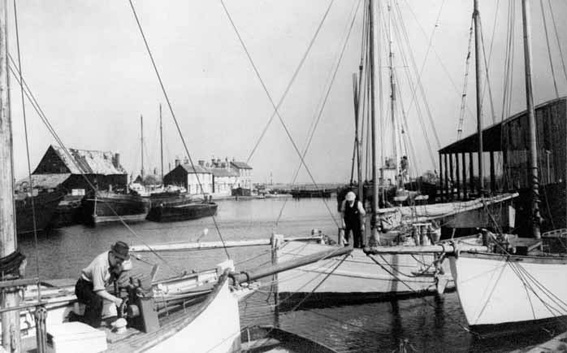
(above) When the war
ended in 1945 the Maldon and Burnham Standard sent a photographer
to the Basin to get a picture of the changes taking place. Darby
said my father and I were asked to carry out some work on the
decks of our boats so that it looked as if things were returning
to normal. In the photo you can see me in a trilby hat (Darby)
on board 'Helene' and dad (C.C.L.Stebbens) on 'Gracie'. Also
in the picture are two canal lighters, 'Agnes' and 'Seven Sisters'
and various cut down sailing barges, 'Olive Branch', 'Unity',
'Rose', and 'Beryl'. |
|
The
following is from an interview with 'Darby' in later life.
I have lived in the village all my life. As a boy I used to walk
the mile, with the other Basin children, along the canal tow
path to school in Heybridge. At the end of the day my cousin
Dick and I would race to the Wave Bridge to hitch a lift home
on the canal barges returning from Chelmsford; they would nearly
always arrive around half past three. 'Tulip' Clark and Albert
'Tiny' Woodcraft, my uncle, worked for Brown's all their lives.
They would bring the barge in close to the walkway under the
bridge and help us aboard. 'Now you be careful, boy', they would
say, 'We don't want you falling in'. In the early days they used
to go all the way to Chelmsford with a loaded barge and bring
an empty one back - in later years they used to change over with
the Chelmsford men at Paper Mill.
When I left school I helped Cecil, my dad, look after and skipper
gentlemen's yachts. There were always plenty of boats to maintain,
the Basin was a favourite place for wintering yachts and many
well known local people kept their boats there, Dr Henry brought
Dudley Courtman, and his twin brother, into the world at Chelmsford
Hospital - a long time ago!, the gynaecologist from Chelmsford,
had the 'Ophelia'; and Dr. Matthews, who would sometimes sail
to the Baltic for lecture tours, had the 'Lucretia'. I still
have some of the old bills that my father sent them for work
he had done on their yachts. |
|
His father, like his father
before him, was a Trinity House river pilot. He learned about
the river sailing barges around the coast before becoming a skipper
himself. When my grandfather was asked to become licensee of
'The Old Ship' he gave up his pilot's licence and my dad took
it over. Father was a pilot for the next 45 years and I worked
with him for 25 of them. |
|
I remember the day in
1942 when the lock keeper, Jack Ellis, who lived in this house,
The Anchorage, was drowned one night in the lock. He slipped
on ice and hit his head on the railings. They couldn't search
in the dark but in the morning my father was the first to find
him and helped to get his body out. It was an awful thing which
upset everyone for ages. Jack was my uncle and I still have the
cards which were printed for his funeral. |
After Uncle Jack died,
Francis Stunt, the Company's chief, called to see my father.
Although my dad was river pilot at the time he was asked to take
over as lock keeper as well, as he was the only local man who
had enough experience. To be close to the job we all went to
live in Lock House and I looked after the lock when my dad was
away doing his pilot's job. There were always things to do looking
after the gates. Even during the war the Canal Company still
carried out their annual inspections and I had to paint up the
lock.
One day during the war three Scottish drifters came down to the
Basin to be prepared as mine-sweepers. I operated the locks when
my father took them away - they all had to lock out on one tide
to be towed to Brightlingsea, so you couldn't waste time. Depending
on the draught of the boat and height of tide, you only had time
for four or five lockings. Around that time one or two sailing
barges came into the Basin carrying timber from London. There
was a Captain Morgan with the sailing barge 'Gladys', and my
brother Cecil, who was mate on the 'Memory'. The timber was off-loaded
onto the canal barges and was towed by horse to Chelmsford by
'Tulip' ClarkThere were so many Clark's and members of the same
family's in the Basin that they had to have specific nicknames-
'Tulip' was named after his horse. Others were 'Trooper', 'Dilbury'
and 'Tinker', and 'Skinny' Woodcraft. The horses were stabled
behind the Jolly Sailor, and The Old Ship. They would journey
up one day and come back the next. Timber was scarce in wartime
and Scottish fir was used, which was a lot heavier to handle
than Baltic timber. |
The other barge skippers
who called at the Basin were the Keebles, the Springetts, and
Pup Simmons, all from Maldon, and Jack Petitt from Pin Mill,
sailing such barges as the 'Mayflower', 'Ethel Ada', 'Maud',
'Aldwick', and 'Gladys'. One cargo was bomb rubble from London
to be unloaded at the Hythe Quay, Maldon, for the building of
the runway at Birch for the American bombers. I remember seeing
fourteen barges tied up at once. As well as rubble some carried
grain and others bricks. Some had moorings just 'off the lock'
opposite the Basin.
The 28th Company Royal Army Service Corps was stationed in the
Basin during the war. They had three or four motorised wooden
barges to carry their machinery, together with a "Tid"
tug, a bit like the old steam tug Brent which you can still see
at the Hythe in Maldon. There were also a dozen or more Thames
lighters tied up all along the sea wall as far as Mill Beach
ready for D-Day. They must have been in one heck of hurry to
get away because on the day they left they just threw all their
mooring chains overboard and left them on the shore. What they
used to tie up with when they arrived I'll never know. |
There was a lot of military
activity around the Basin with soldiers and sailors billeted
at The Towers in Heybridge and in the Manor House on Osea Island.
Certain boats in the Basin were commandeered for military services:
the yacht Francis II, for example, was turned into a river patrol
boat and was moored off Osea.
One night Lord Haw Haw which was the name given to William Joyce,
a German sympathiser, who regularly broadcast propaganda during
the war. He joined the Nazi movement in England in 1939 and fled
to Germany as war broke out. His intimate knowledge of Essex
was rather disconcerting although he made a mistake with the
location of the submarine base because it was on Osea Island
in the First World War! told us on the radio that German planes
were going to bomb the submarine base at Heybridge Basin. The
attack happened several nights later: six people were killed
and several houses received direct hits. It was at that time
that we heard that Jan Bottomer, a Dutch skipper who used to
come to the Basin with his boat, had been sent to a German POW
camp for belonging to the Resistance; it was said that he helped
escaping British airmen.
There were frequent air raids as German planes flew up the river
thinking it was the Thames. At night our family went and slept
on our boat, Gracie, moored on the saltings, so that we would
not have the house fall down on us if we were bombed. One night
a land mineThese mines were dropped by parachute and were therefore
silent until they hit the ground! landed right next to the house
on Northey Island making quite a thump, but there wasn't much
damage because it went into the soft mud. When I was at Mill
beach one day I saw a Hurricane crash near the Doctor's buoy
off Osea. |
 |
|
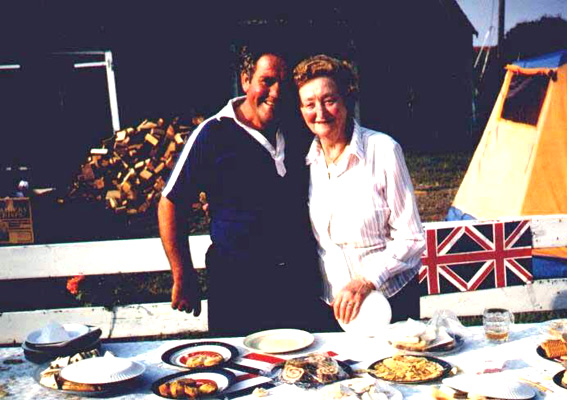
(above) 'Darby' and Mona Clark. 1977 Jubilee Village celebrations. |
|
 |
|
(above) 'Darby' and son David. 1980's |
|
 |
 |