|
Heybridge Basin (Cannibal
Island) |
|
|
Click
on underlined blue names for link to more details |
|
|
The
Village Tour |
|
Page
Two |
|
|
|
Over the next period from
about 1806 till the 1950's most of the village as it stands today
(1996) was built. For many years the village began at 'Tinkers
Cottage', with the three semi-detached dwellings originaly listed
as Nos 1 to 6 Basin Road now re-numbered as Nos 81 to 91. The
deeds of No4 show it was constructed in 1806 with a considerable
amount of new building over the next 50 years or so. The old
Barn now known as 'The Barn House' was of course just outside
the village. Most of the early pictures available are of the
period 1900 to 1930. |
|
Begining at the Toll Gate
end of Basin Road, the dwellings on both sides of the road including
Harfred Avenue up as far as the bend by St
George's Church are quite new (relatively speaking). The
wooden dwellings on the right hand side as you procede from the
toll gate, and the building of St George's
Church were originally WW1 Ministry of War buildings moved
to to their respective sites and re-erected around 1919. The
Basin Road ones were transported from Osea Island Naval Base
and erected by May and Butcher
(as were several others around the village, including along Goldhanger
Road). The one that was set up and used as St
Georges Church came from Stow Maries RAF base. It was at
this corner that one of the village ponds was in existance for
many years, as well as the arrival and turning point of bus services
to the village. The place affectionately known by recent generations
as 'the bus stop'. |
 |
|
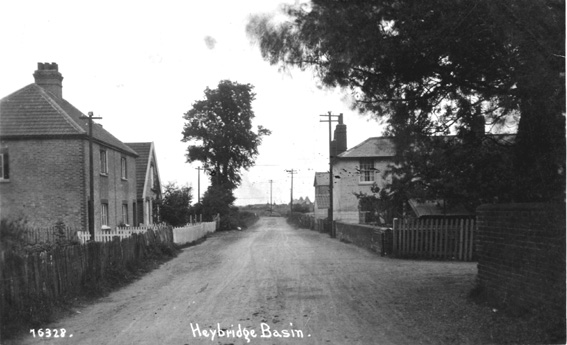
(above) this view taken
just after the turn of the 20th Century, looking down the road
towards the corner, is actually from a point looking out and
away from the original village. The pointed roof of 'Spray
Cottage' with the white fence is on the left, behind the
tree is where the Council Houses were built in the 50's, the
mill in Goldganger Road can be seen in the far distance. |
|
|
Moving further into the
village, a couple of houses past 'Spray
Cottage', is a cottage named 'Veronique', which in more recent
years Mrs Sheldrake ran a
small shop from her front-room. Next of interest on the left
where Maritime Avenue starts, was once the entrance to 'May
& Butcher'. just before we reach the Barn on the left
(now converted into a residence), is what was once a butcher's
shop run by Mr Wakelin . Moving on
to the Barn, this was originally owned and probably built by
Mr Going but later was believed to have been used by Ernest
Hume as part of his dairy business. Next to the barn was
one of the village smithy's which was operated also by Joseph
Going along with many other concerns he had in the village.
Almost opposite the barn on the other side of the road was the
entrance into another timber yard 'Blackwater
Timbers'. |
 |
|
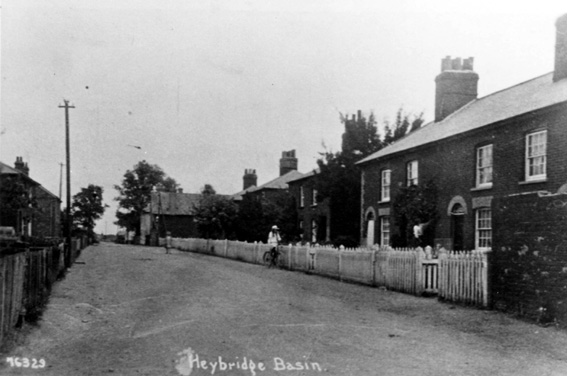
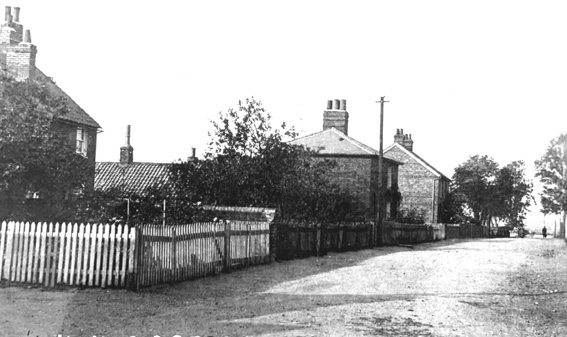
(above
& below) Looking down towards the
Barn (the large building near the big tree on the right). The
girl on the bicycle is outside 'Peartree Cottage' No6 Basin Road,
later renamed 'Pilot Cottage'. The high wall on the extreme right
is part of the coal yard, and also in the bottom picture. The
postmark of the bottom card is August 1815. |
 |
|
|
Between the barn and No1
Basin Road stood the Dairy and produce stores run by Mr
Hume and his family. No1 Basin Road was known as 'Tinkers
Cottage', rented for some years by Charles
'Tinker' Clark and his wife who ran a small sweet and tobacconist
shop from the side of their house. The semi-detached houses next
numbering 1 to 6 Basin Road were built from local red mud-bricks
with yellow brick edgings and timber and wood (mainly from old
ships). |
 |
|
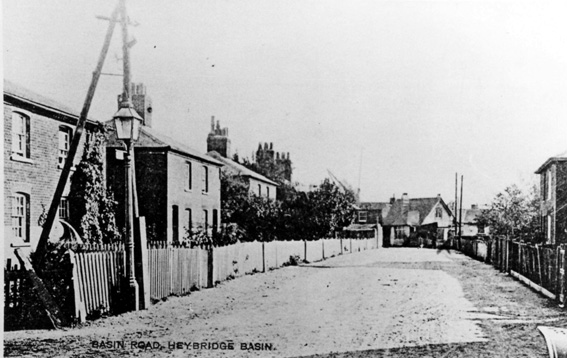
(above) looking towards what is now the car-park corner,
the photographer is standing in the road opposite the lane between
the barn and No1 Basin Road. In the distance can be seen Sam Purkiss's Stores. |
|
|
Heading towards the corner
on the left No5 Basin Road (Ivy Cottage), was a general store
and Post Office run by Connie
Laister. Just before the very end on the left was the coal
yard operated by the Going family first
and then Mr Pearmain, who also had
a piggery there. On the opposite side of the road, on the right
hand side on the corner of what we call 'Chapel Lane', stands
a large building that was once 'The Exchange'
public house with a piggery and stables attached. For many years
the places for villagers to wring their clothes was each side
of the road in front of the old 'Exchange'. Up the lane was a bakery which changed hands several
times over the years Peter Saffen,
John Mitson and Charles
Warraker are three that we know of. Most of the properties
covered so far were rented by their occupiers and became part
of the great sale and auction of September the 16th 1873. |
|
|
 |

